https://en.wikipedia.org/wiki/Dragon_of_Wantley
This tale about a knight killing a dragon in a suit of Sheffield steel is a thinly veiled attack on the Earl of Shrewsbury (soon to be the Duke of Norfolk), the areas largest landowner and eventually the most senior peer in the realm.
In 1573 a lawsuit was taken against the Lord of the Manor of Sheffield, George Talbot, the sixth Earl of Shrewsbury. The lord was accused of appropriating the proceeds of Sheffield ‘waste’ land, which hitherto had paid for civic works, church upkeep, and helping the poor. The crusading lawyer who took the case on behalf of the people of Sheffield was named George More who lived by Wharncliffe Crags.

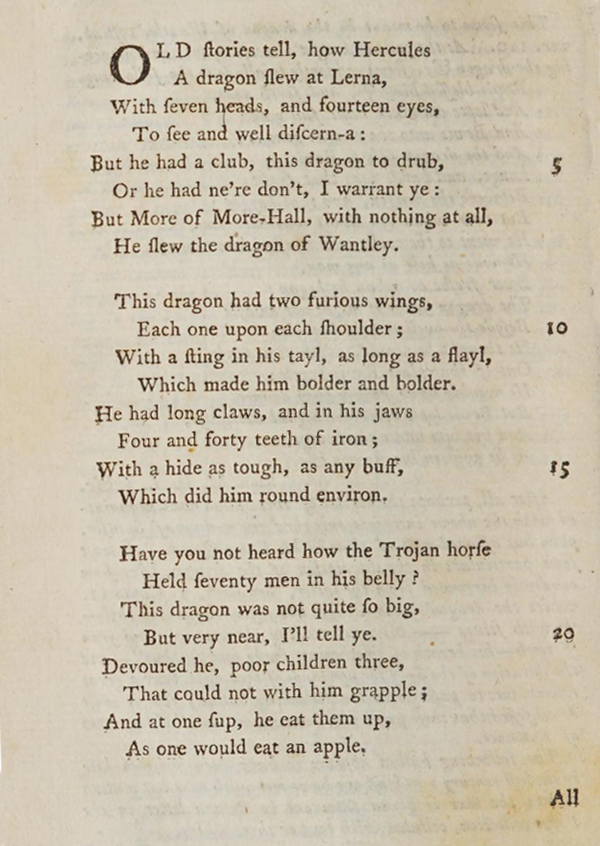
Old stories tell, how Hercules
A dragon slew at Lerna*,
With seven heads and fourteen eyes,
To see and well discern-a :
But he had a club, this dragon to drub,
Or he had ne’re don’t, I warrant ye:
But More of More-Hall, with nothing at all,
He slew the dragon of Wantley.
This dragon had two furious wings,
Each one upon each shoulder ;
With a sting in his tail,
as long as a flail,
Which made him bolder and bolder.
He had long claws, and in his jaws
Four and forty teeth of iron;
With a hide as tough, as any buff,
Which did him round environ,
Have you not heard how the Trojan horse
Held seventy men in his belly ?
This dragon was not quite so big,
But very near, I’ll tell ye.
Devoured he, poor children three,
That could not with him grapple;
And at one sup, he eat them up,
As one would eat an apple.
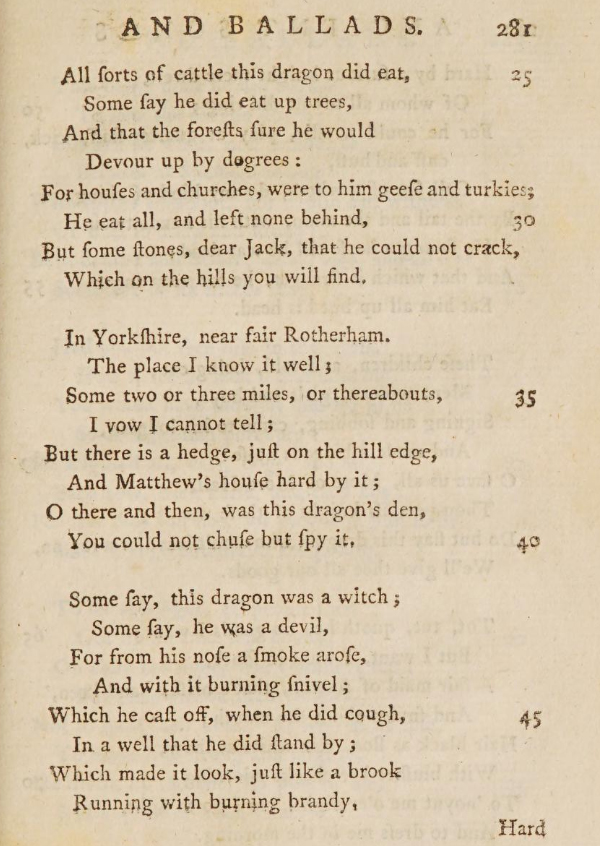
All sorts of cattle this dragon did eat,
Some say he did eat up trees,
And that the forests sure he would
Devour up by degrees :
For houses and churches,
were to him geese and turkies;
He ate all, and left none behind,
But some stones, dear Jack,
that he could not crack,
Which on the hills you surely will find,
In Yorkshire, near fair Rotherham.
The place I know it well;
Some two or three miles, or thereabouts,
I vow I cannot tell;
But there is a hedge, just on the hill edge,
And Matthew’s house hard by it;
O there and then, was this dragon’s den,
You could not choose but spy it
Some say, this dragon was a witch
Some say, he was a devil,
For from his nose a smoke arose,
And with it burning snivel ;
Which he cast off, when he did cough,
In a well that he did stand by ;
Which made it look, just like a brook
Running with burning brandy,
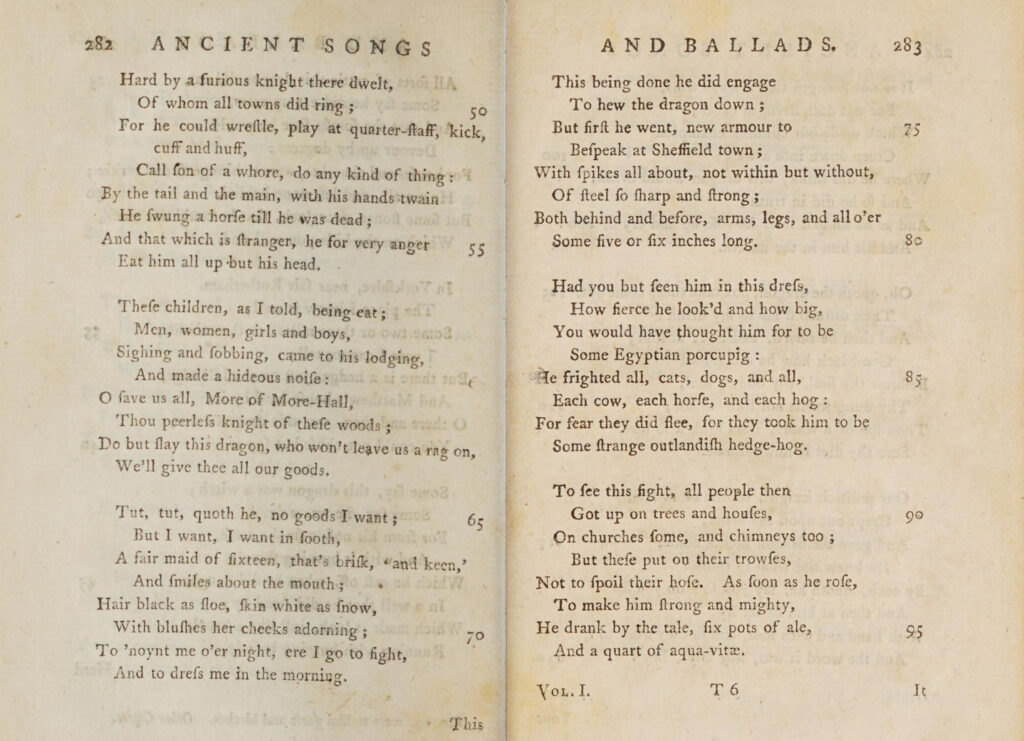
Hard by a furious knight there dwelt,
Of whom all towns did ring ;
For he could wrestle, play at quarter-staff, kick, cuff and huff,
Call son of a whore, do any kind of thing:
By the tail and the main, with his hands twain
He swung a horse till he was dead ;
And that which is stranger, he for very anger
Eat him all up but his head
These children, as I told , being eat;
Men, women, girls and boys,
Sighing and fobbing, came to his lodging,
And made a hideous noise:
O save us all, More of More-Hall,
Thou peerless knight of these woods ;
Do but slay this dragon, who won’t leave us a rag on,
We’ll give thee all our goods.
Tut, tut, quoth he, no goods I want
But I want, I want in truth,
A fair maid of sixteen, that’s brisk, and keen,
And smiles about the mouth;
Hair black as sloe, skin white as snow,
With blushes her cheeks adorning
To anoynt me o’er night, ere I go to fight,
And to dress me in the morning
This being done he did engage
To hew the dragon down ;
But first he went, new armour to
Bespeak^ at Sheffield town ;
With spikes all about, not within but without,
Of steel so sharp and strong ;
Both behind and before, arms, legs, and allo’er
Some five or fix inches long,
Had you but seen him in this dress,
How fierce he look’d and how big,
You would have thought him for to be some Egyptian porcupig :
He frighted all, cats, dogs, and all,
Each cow, each horse, and each hog :
For fear they did flee, for they took him to be
Some strange outlandish hedge-hog.
To see this fight, all people then
Got up on trees and houses,
On churches some, and chimneys too ;
But these put on their trouses,
Not to spoil their hose. As soon as he rose,
To make him strong and mighty,
He drank by the tale, fix pots of ale,
And a quart of aqua-vite.
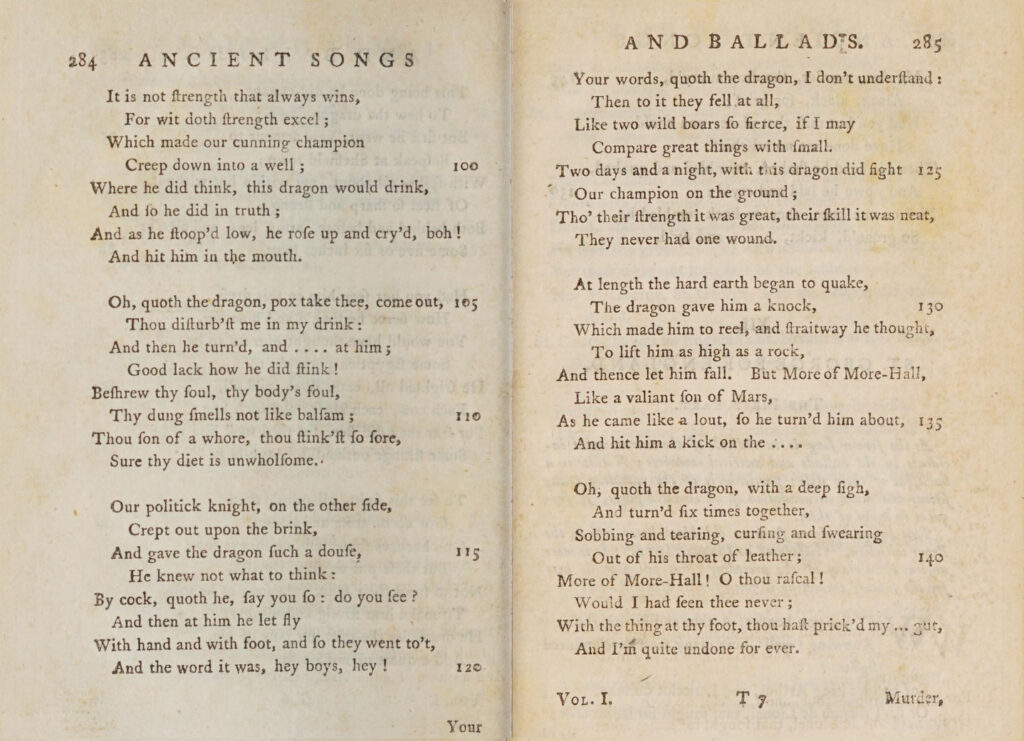
It is not strength that always wins,
For wit doth strength excel ;
Which made our cunning champion
Creep down into a well ;
Where he did think, this dragon would drink,
And so he did in truth ;
And as he stoop’d low, he rofe up and cry’d, boh!
And hit him in the mouth.
Oh, quoth the dragon, pox take thee, come out,
Thou difturb’st me in my drink:
And then he turn’d, and …. at him;
Good lack how he did stink!
Beshrew thy foul, thy body’s foul,
Thy dung smells not like balsam ;
Thou son of a whore, thou stink’st so sore,
Sure thy diet is unwholsome..
Our politick knight, on the other side,
Crept out upon the brink,
And gave the dragon such a douse,
He knew not what to think:
By cock, quoth he, say you so: do you see?
And then at him he let fly
With hand and with foot, and so they went to’t,
And the word it was, hey boys, hey!
Your words, quoth the dragon, I don’t understand :
Then to it they fell at all,
Like two wild boars so fierce, if I may
Compare great things with small.
Two days and a night, with this dragon did fight
Our champion on the ground ;
Tho’ their strength it was great,
their skill it was neat, They never had one wound.
At length the hard earth began to quake,
The dragon gave him a knock,
Which made him to reel, and straitway he thought,
To lift him as high as a rock,
And thence let him fall.
But More of More-Hall,
Like a valiant son of Mars,
As he came like a lout, so he turn’d him about,
And hit him a kick on the arse
Oh; quoth the dragon, with a deep sigh,
And turn’d fix times together,
Sobbing and tearing, curfing and swearing
Out of his throat of leather
More of More-Hall! O thou rascal!
Would I had seen thee never ;
With the thing at thy foot, thou haft prick’d my gut
And I’m quite undone for ever.
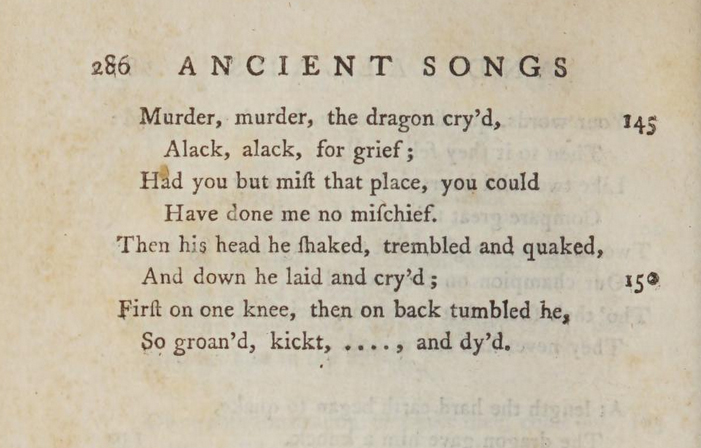
Murder, murder, the dragon cry’d,
Alack, alack, for grief ;
Had you but missed that place, you could
Have cone me no mischief.
Then his head he shaked, trembled and quaked,
And down he laid and cry’d
First on one knee, then on back tumbled he,
So groan’d, kickt, fart’d, and died.
- Lerna was an entrance to the Underworld in Greek mythology guarded by a Hydra, a serpentine lake monster
^ bespeak is to order in advance