We are performing from 5-7pm, followed by food then a ceilidh!
tickets from https://www.eventbrite.co.uk/e/get-your-goat-street-goat-party-tickets-33652959909
facebook event – https://www.facebook.com/events/1314764418613851/
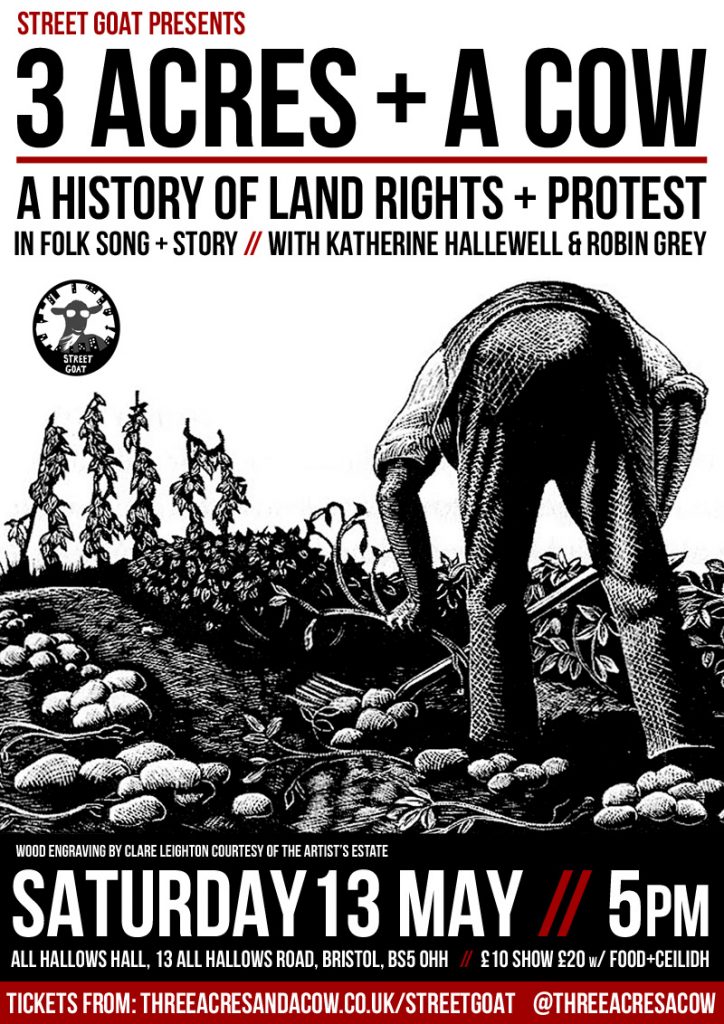
We are performing from 5-7pm, followed by food then a ceilidh!
tickets from https://www.eventbrite.co.uk/e/get-your-goat-street-goat-party-tickets-33652959909
facebook event – https://www.facebook.com/events/1314764418613851/
The full title is ‘The Cottager’s Complaint, on the Intended Bill for Enclosing Sutton-Coldfield’ and it was written by John ‘Poet’ Freeth (1731-1808) the owner of Freeth’s Coffee House in Birmingham and a well known poet and songwriter. He published a book called ‘The Political Songster: Or, a Touch on the Times, on Various Subjects, and Adapted to Common Tunes’ which went to at least 6 editions.
How sweetly did the moments glide, how happy were the days!
When no sad fear my breast annoyed, or e’er disturbed my ease;
Hard fate! that I should be compelled my fond abode to lose,
Where threescore years in peace I’ve dwelled, and wish my life to close.
Chorus
Oh the time! the happy, happy time, which in my cot I’ve spent;
I wish the church-yard was his doom, who murders my content.
My ewes are few, my stock is small, yet from my little store
I find enough for nature’s call, nor would I ask for more!
That word, ENCLOSURE ! to my heart such evil doth bespeak,
I fear I with my all must part, and fresh employment seek.
Chorus — Oh the time, &c.
What little of the spacious plain should power to me consign,
For want of means, I can’t obtain, would not long time be mine:
The stout may combat fortune’s frowns, nor dread the rich and great;
The young may fly to market-towns, but where can I retreat?
Chorus — Oh the time, &c.
What kind of feelings must that man within his mind possess,
Who, from an avaricious plan, his neighbours would distress?
Then soon, in pity to my case, to Reason’s ear incline;
For on his heart it stamps disgrace, who formed the base design.
Chorus
Show with Rachel Rose Reid, Katherine Hallewell and Robin Grey.
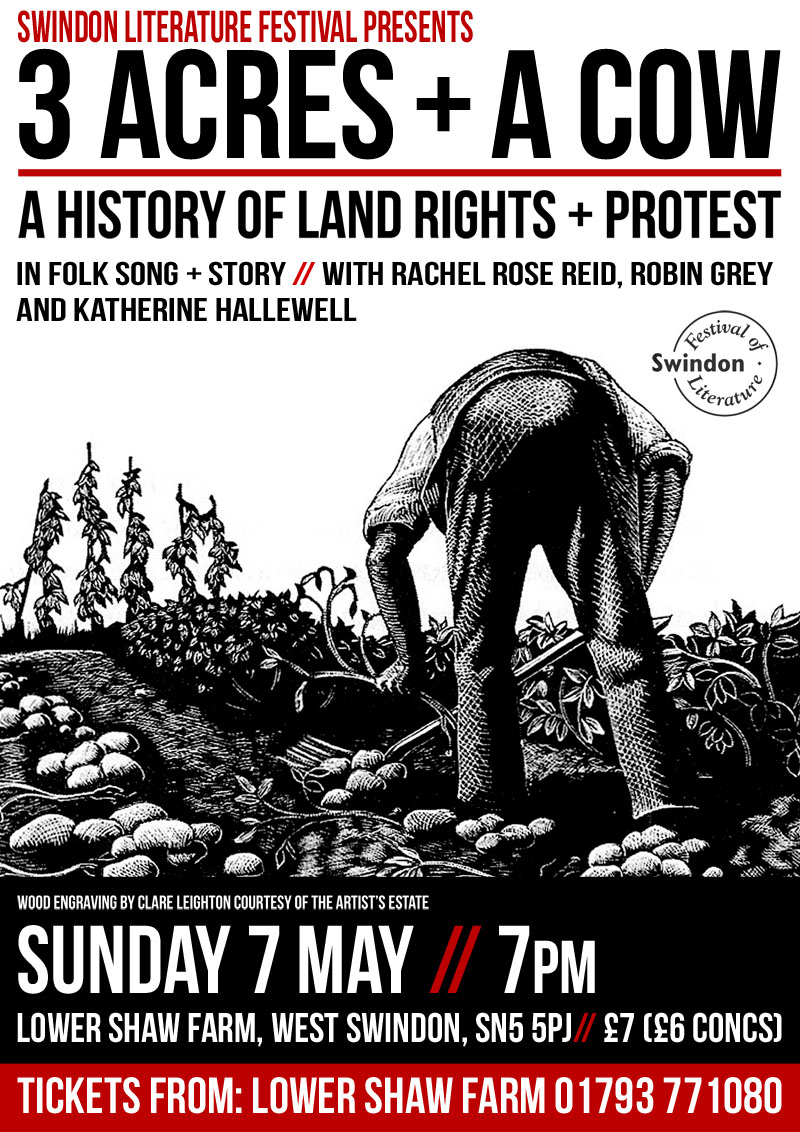
Reserve a spot (£7/6) by calling 01793 771080
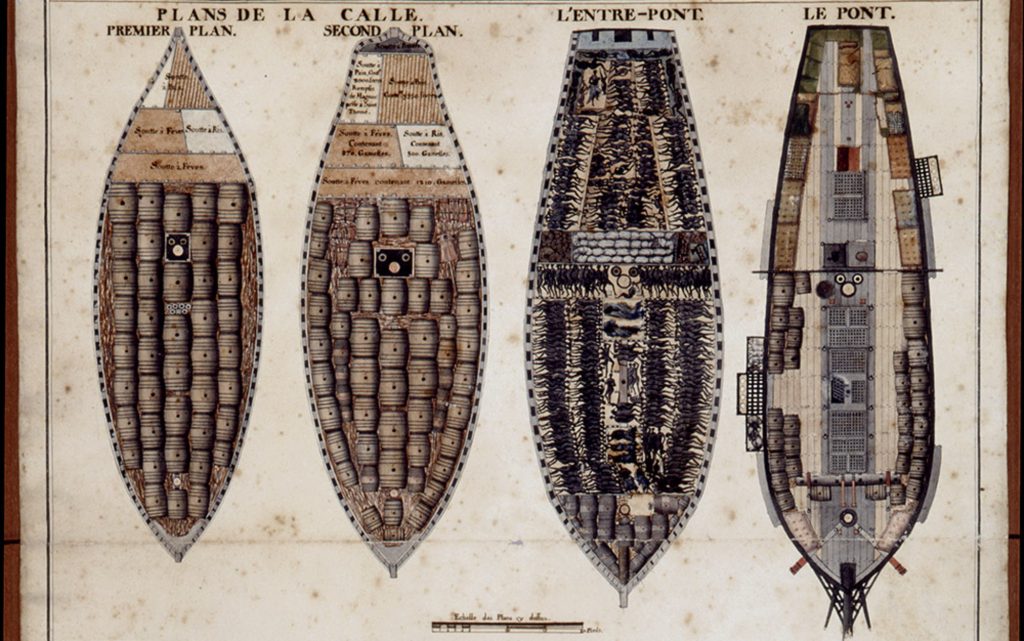
The evolution of capitalism in England and resulting land grabs both here and abroad can be arguably simplified to sheep, slavery and fossil fuels…
I found this (long read) article an excellent overview of the abominable role slavery took in the founding of modern day economics.
https://aeon.co/essays/why-the-original-laissez-faire-economists-loved-slavery
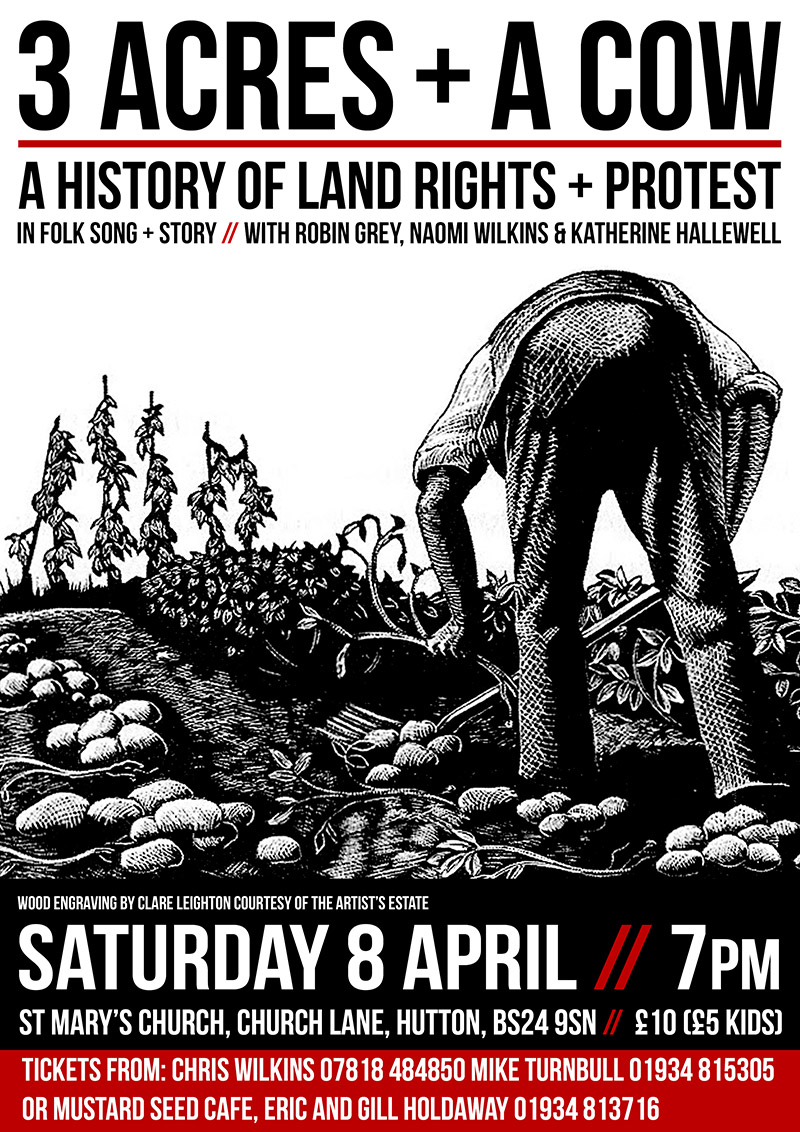
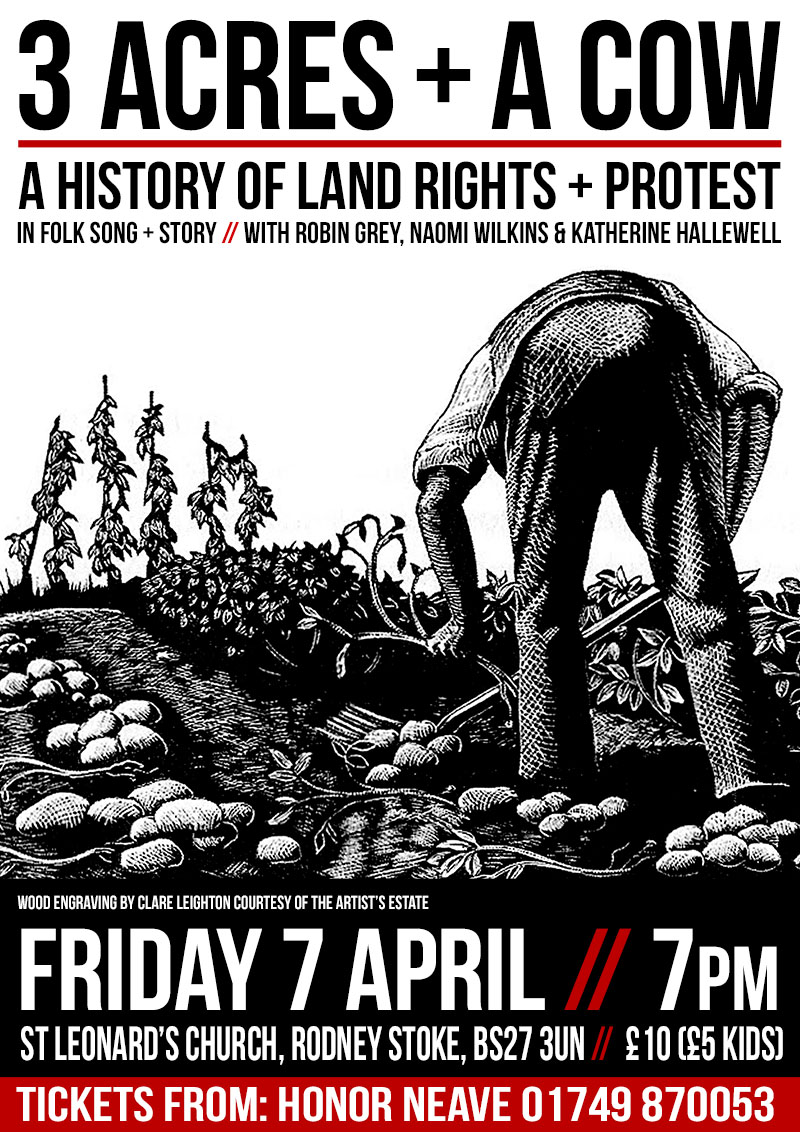
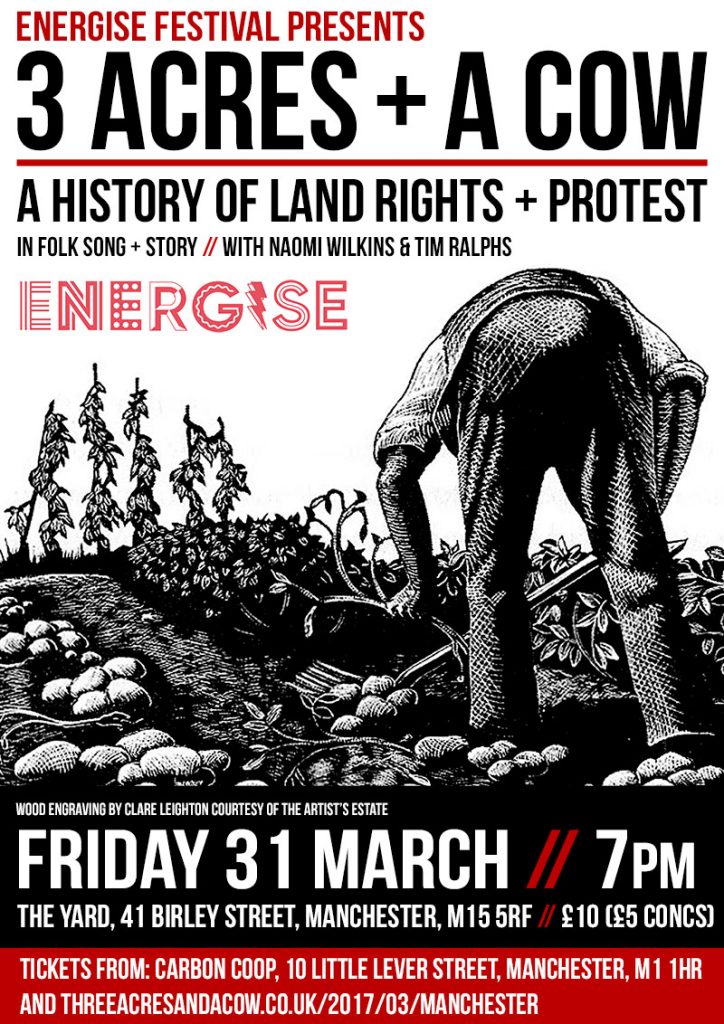
tickets from https://app.etickets.to/buy/?e=14911
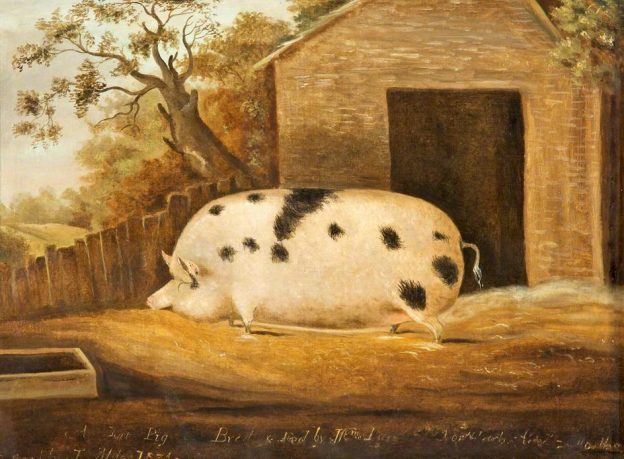
More info at a folk song a week blog – https://afolksongaweek.wordpress.com/2013/08/10/week-103-petition-of-the-pigs-in-kent/
Original text in 1809 magazine can be found here
Petition of the Pigs in Kent
Ye owners of woodlands, with all due submission,
We humbly beg leave to present our petition,
That you will be pleas’d to recall your decree,
Which tells us that acorns no longer are free.
In Sussex and Surrey and Middlesex too,
Pigs may ramble at large without such ado;
And why, then, in Kent should pretences be found,
To drive us like culprits and thieves to the pound,
Since we, and our fathers, and others before ‘em,
Have rang’d in your woods, with all proper decorum?
No poachers are we, for no game we annoy
No hares we entrap, and no pheasants decoy;
Contented are we, if an acorn we find,
Nor wish for a feast of a daintier kind.
Besides, we are told (and perhaps not mistaken)
That you and your friends love a slice of good bacon;
But if of good bacon you all love a slice,
If pigs are to starve, how can bacon be nice?
For these and for other wise reasons of state,
We again our petition most humbly repeat,
Ye owners of woodlands, with all due submission,
We humbly beg leave to present our petition,
That you will repeal this severest of laws,
So your woods shall resound to our grunting applause.
 Some good stuff in these PDF’s by Sing London
https://www.efdss.org/efdss-education/resource-bank/resources-and-teaching-tools/singing-histories
Just currently looking at the ‘Petition of the Pigs in Kent’ ballad from the Kent book… https://media.efdss.org/resourcebank/docs/EFDSS_Education_RecentProjects_SingingHistoriesKent.pdf
Severine from The Greenhorns just sent me this ace song about the Land Corporation of Ireland by Duncan Bourne.
Bill Finney was an ancestor of Duncan’s. His son (William) was born in Ireland and for a long time he thought that the Finneys were of Irish decent. Given that Finney is also an Irish surname. However further research revealed a long standing Staffordshire branch of Finney.
The Land Corporation of Ireland arose out of the 1879 – 1882 Land War, which saw the rise of Irish Nationalism and gave us the word “boycott”. From the summer of 1879 the Land League carried out various activities aimed at preventing the forced eviction of tenants who had fallen into arrears due to recession. These activities ranged from ostracism (the boycott), protests at the sale of leases, riots and, although not officially sanctioned, assassinations. One organiser Michael Boyton advocated that land grabbers (people who took the land of evicted tenants) should be “given the pill” ie. shot. By 1882 the Land League had been suppressed and the Reform Bills of 1884 & 1885 gave voting rights to tenants as well as the promise of reduced rents, though these did not always materialise. The Land Corporation of Ireland was set up to work land that had fallen idle due to evictions but due to the Land War it was nigh on impossible to recruit from the local population and so “caretaker” farmers were recruited from England through letters sent to local parishes. Bill Finney was one such farmer.
Lyrics
I come from Wootton, Staffordshire Bill Finney is my name
And I sought employment where I could you name it, I was game
I started down the Holly Bush serving in that drovers inn
And through talking with those droving lads my travels did begin
Come all you eager labouring lads keen for some work to do
The Land Corporation of Ireland has just the job for you
I tried my luck in the Potteries towns but my efforts came to nought
So I travelled up to Middlewich and worked there with the salt
T’was there I saw a letter requesting men to farm
For the Land Corporation of Ireland and I thought, “well what’s the harm?”
Come all etc.
We’ll pay you ten to fifteen bob to work some idle land
Where used to live a family evicted out of hand
You’ll have a house and garden and a free allowance of fuel
But don’t expect a social life your reception may be cruel
Come all etc.
So I went to Tipperary away from England’s shore
And I learned about the hardship caused by the old Land War
I learned about the ‘Boycott’ and the giving of the ‘Pill’
And of the broken promises caused by the Reform Bill
Come all etc.
And so I am a caretaker on land of sorrows shame
Don’t blame me for being English sir there’s Irish in my name
My name it is Bill Finney come drink with me a while
The Land Corporation of Ireland are the ones you should revile
Come all etc.
2014 documentary about tenants’ rights, organised prevention of evictions and gentrification in Berlin. Can someone please organise a screening and invite us?
http://rentrebels.tumblr.com/film

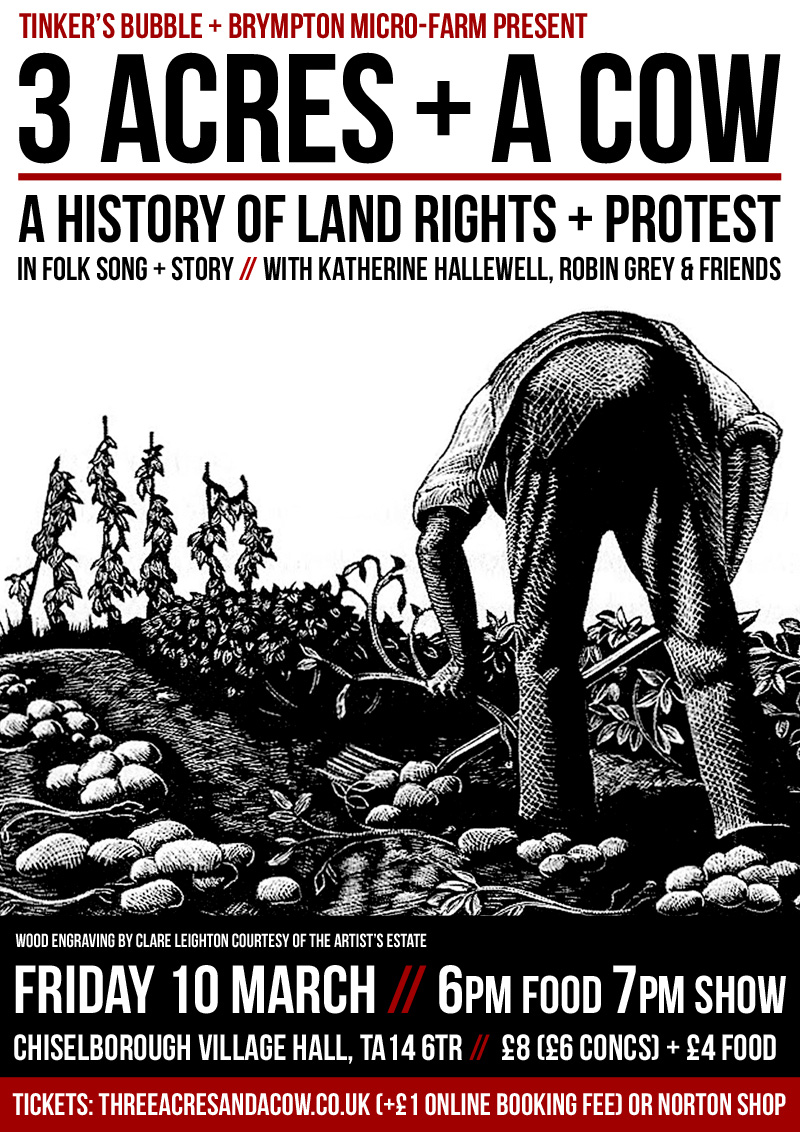
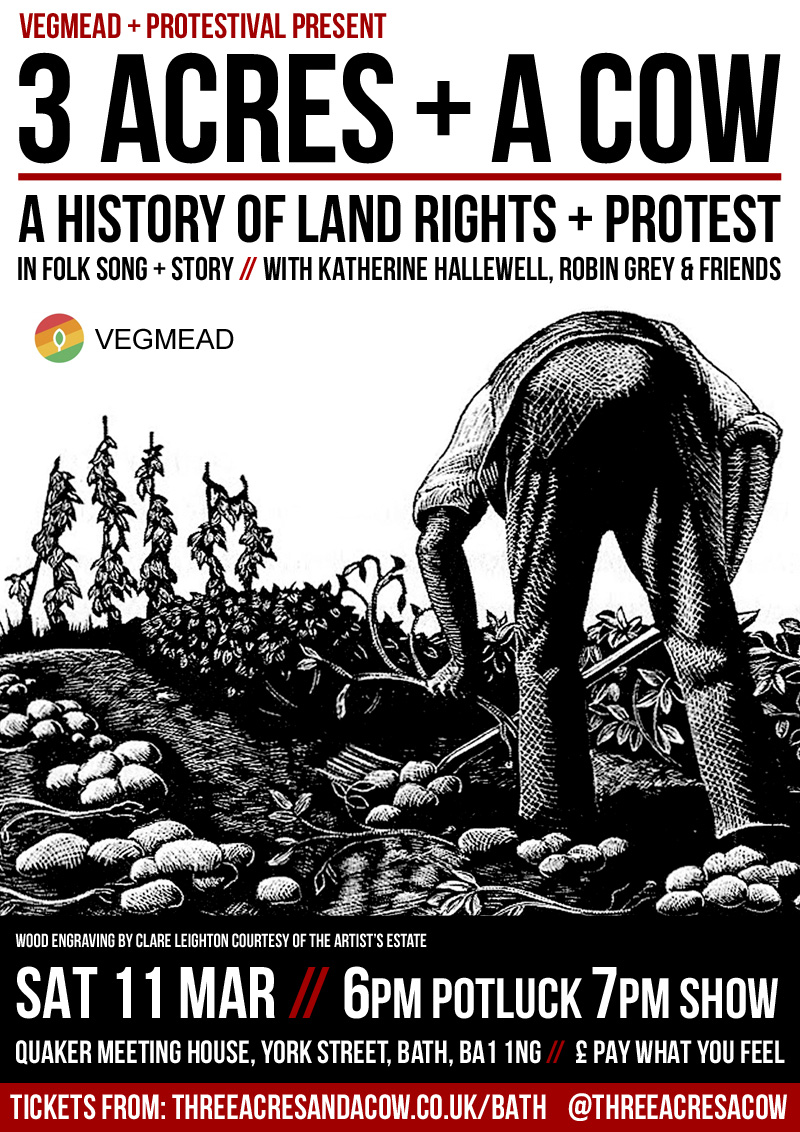
Friday 10th March @ Chiselborough Village Hall, TA14 6TR
tickets from https://app.etickets.to/buy/?e=14715
facbook page – https://www.facebook.com/events/1322634664426051/
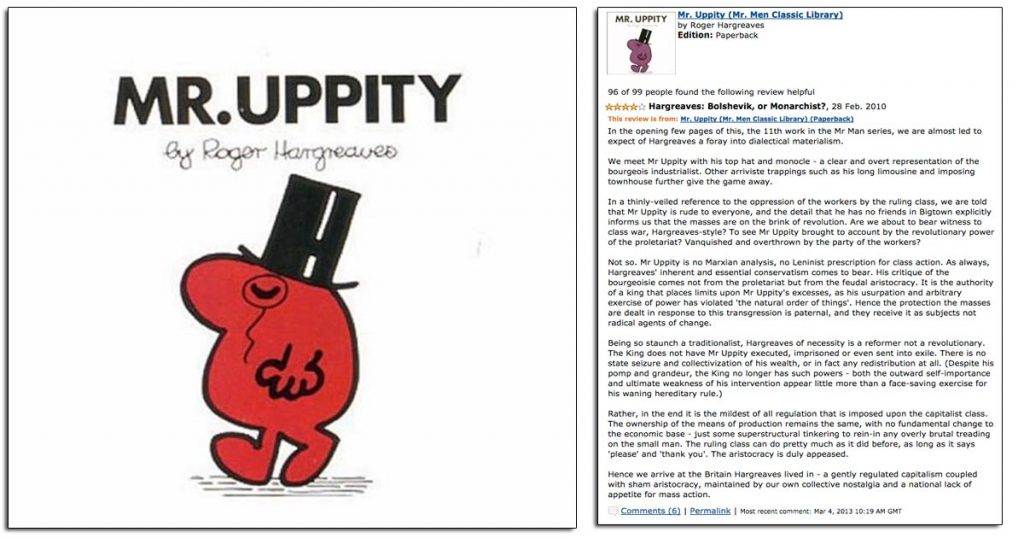
This article provides a nice example of how we are conditioned to think in a certain way from the youngest age! Greedy factory owner vs the workers and the king has to intervene…
http://www.thepoke.co.uk/2016/03/01/literary-criticism-mr-men-reviews-made-us-laugh-lot/
*** this website is now dead – luckily you can find an archived version of it here – https://web.archive.org/web/20170308111703/http://gerald-massey.org.uk/jones/c_poems_2.htm ***
Wow – this website is amazing – http://gerald-massey.org.uk/
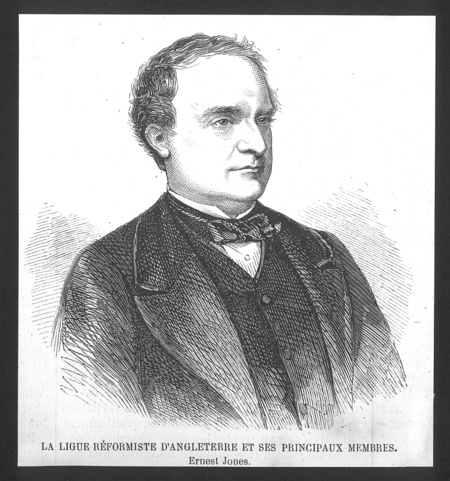
I found it when looking for the full words of ‘Our Summons’ by Ernest Jones which took me to here – http://gerald-massey.org.uk/jones/c_poems_2.htm – he wrote most of his poetry in his own blood whilst in prison. What to say. Lost for words.
OUR SUMMONS.
Men of the honest heart,
Men of the stalwart hand,
Men, willing to obey,
Thence able to command:
Men of the rights withheld,
Slaves of the power abused,
Machines cast to neglect,
When your freshness has been used.
Ye labourers in the vineyard,
We call you to your toil!
Though bleak may be the furrows,
The seed is in the soil.
‘Tis not to raise a palace,
Where Royalty may dwell,
Nor build for broken hearts
The petty parish hell;
‘Tis not to turn the engine,
‘Tis not the field to till,
That, for the meed you gain,
Might be a desert still!
‘Tis not to dig the grave,
Where the dying miner delves;
‘Tis not to toil for others
But to labour for yourselves.
And nobler coin will pay you,
Than Kings did e’er award
To the men, they hired to murder,
The brothers they should guard.
No glittering stars of knighthood,
Shall soil your simple vest—
But the better star of honour
Brave heart in honest breast.
No changing Norman titles,
To hide your English name—
But the better one of freemen,
With its blazoning of fame.
Up! Labourers in the vineyard!
Prepare ye for your toil!
For the sun shines on the furrows,
And the seed is in the soil.
Ewan McLennan just suggested this song ‘Smile In Your Sleep‘ to me, written by Jim McLean about the Highland Clearances.
Beautiful and achingly sad, I personally wonder if it needs another few verses, as I felt from The Cheviot The Stag and The Black Black Oil, that there were a number of defiant pockets of (mostly female) resistance to the Clearances which this song doesn’t touch on.
Hush, hush, time tae be sleepin
Hush, hush, dreams come a-creepin
Dreams o peace an o freedom
Sae smile in your sleep, bonnie baby
Once our valleys were ringin
Wi sounds o our children singin
But nou sheep bleat till the evenin
An shielings stand empty an broken
We stood, wi heads bowed in prayer
While factors laid our cottages bare
The flames fired the clear mountain air
An many lay dead in the mornin
Where was our fine Highland mettle,
Our men once sae fearless in battle?
They stand, cowed, huddled like cattle
Soon tae be shipped owre the ocean
No use pleading or praying
All hope gone, no hope of staying
Hush, hush, the anchor’s a-weighing
Don’t cry in your sleep, bonnie baby
Catherine Shoard came to see the show on Saturday and has given us a nice mention in her Guardian column:

“One downside of increased mass political activism is all the loudspeakers. There are few noises more grating than an elderly megaphone hectoring out some battle cry, chanted back by croaky crowds. On repeat, for hours, it can get a bit wearying.
Here’s where musicians ought to come in. The protests of the past were often soundtracked by song. Not just any old tunes, but brilliantly inventive ballads and broadsides, like some of those I heard last Friday at a folk history of land rights called Three Acres and a Cow. This included ditties such as Ewan MacColl’s The Manchester Rambler, dreamed up in 1932 to commemorate the Derbyshire mass trespass – and so fantastically catchy I’d somehow retained it from when I traipsed up Kinder Scout on a 60th anniversary walk in 1992.
Best of all, though, was an 1880s song the show takes its name from, whose chorus runs: “Don’t you wish you had it now, three acres and a cow / Oh you can make good cheese and butter when you get the cow”. To be so excited at the prospect of dairy products that you’re willing to forgo a rhyme is truly inspirational stuff.”
https://www.theguardian.com/commentisfree/2017/feb/22/moonlight-film-critics-moral-high-ground
You must be logged in to post a comment.