Compellingly covers the English Civil War, the American War of Independence, the French revolution, the Haitian revolution, the revolutions of 1848, the Paris commune, the Mexican revolution, and the Russian revolution. http://www.revolutionspodcast.com/
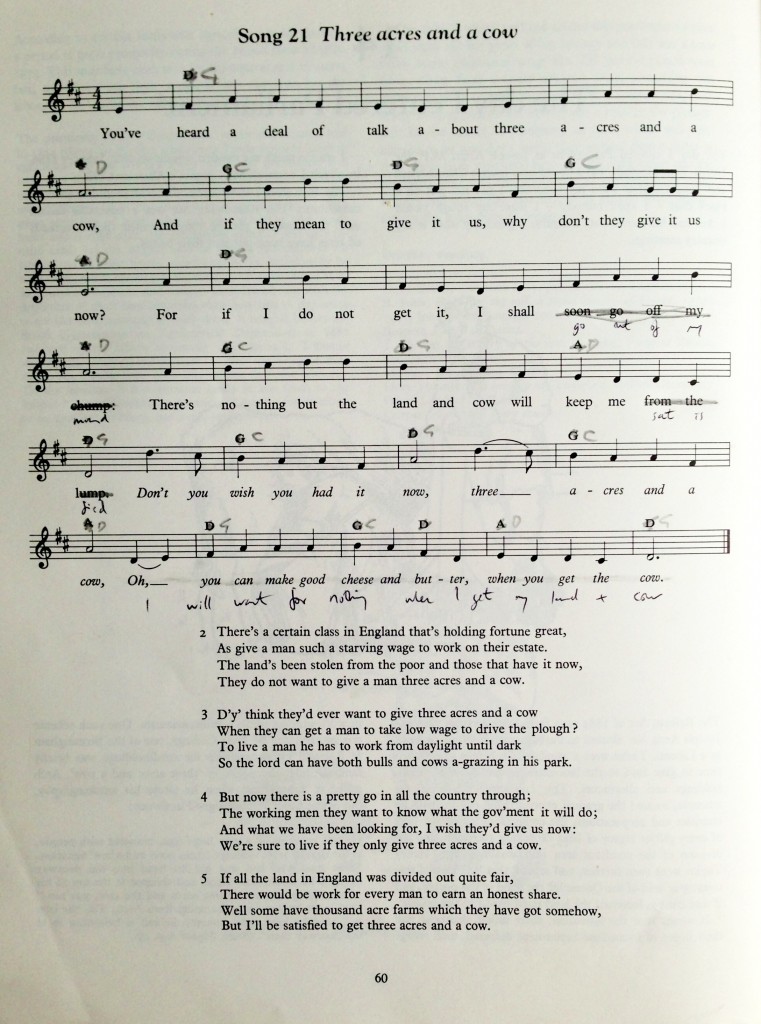
**Please note I have changed some of the lyrics and a bit of the melody – this is fine and you are welcome to change them too – that is how music works #notsacred**
You’ve heard a lot of talk about three acres and a cow
And if they mean to give us why don’t they give it now?
For if I do not get it I may go out of my mind
There’s nothing but the land and cow will keep me satisfied
Don’t you wish you had it now, three acres and a cow!
Oh you can make good cheese and butter when you get the cow.
There’s a certain class in England that is holding fortune great
Yet they give a man a starving wage to work on their estate
The land’s been stolen from the poor and those that hold it now
They do not want to give a man three acres and a cow
D’y’ think they’ll ever want to give three acres and a cow
When they can get a man to take low wage to drive the plough
To live a man he has to work from daylight until dark
So the lord can have both bulls and cattle grazing in his park
But now there is a pretty go in all the country though
The workers they all want to know what the government will do
And what we have been looking for, I wish they’d give us now
We’re sure to live if they only give three acres and a cow
If all the land in England was divided up quite fair
There would be some for everyone to earn an honest share
Well some have thousand acre farms which they have got somehow
But I’ll be satisfied to get three acres and a cow
Lyrics in the public domain
Scan taken from ‘The Painful Plough‘ by Roy Palmer and reprinted with permission.
The Fowlers’ Complaint (The Powtes Complaint) 1611
Come, Brethren of the water and let us all assemble
To treat upon this matter, which makes us quake and tremble;
For we shall rue, if it be true, that the Fens be undertaken,
And where we feed in Fen and Reed, they’ll feed both Beef and Bacon.
They’ll sow both beans and oats where never man yet thought it,
Where men did row in boat, ere the undertakers bought it:
But, Ceres, thou behold us now, let wild oats be their venture,
Oh let the frogs and miry bogs destroy where they do enter.
Behold the great design, which they do now determine,
Will make our bodies pine, a prey to crows and vermine:
For they do mean all Fens to drain, and waters overmaster,
All will be dry, and we must die, ’cause Essex calves want pasture.
Away with boats and rudder, farewell both boots and skatches,
No need of one nor th’other, men now make better matches;
Stilt-makers all and tanners shall complain of this distaster;
For they will make each muddy lake for Essex calves a pasture.
The feather’d fowls have wings, to fly to other nations;
But we have no such things, to aid our transportations;
We must give place (oh grievous case) to horned beasts and cattle,
Except that we can all agree to drive them out by battle.
Wherefore let us intreat our ancient water nurses,
To shew their power so great as t’ help to drain their purses;
And send us good old Captain Flood to lead us out to battle,
Then two-penny Jack, with skales on’s back, will drive out all the cattle.
This noble Captain yet was never know to fail us,
But did the conquest get of all that did assail us;
His furious rage none could assuage; but, to the world’s great wonder,
He bears down banks, and breaks their cranks and whirlygigs asunder.
God Eolus, we do pray, that thou wilt not be wanting,
Thou never said’st us nay, now listen to our canting:
Do thou deride their hope and pride, that purpose our confusion;
And send a blast, that they in haste may work no good conclusion.
Great Neptune (God of seas), this work must needs provoke thee;
They mean thee to disease, and with Fen water choke thee:
But, with thy mace, do thou deface, and quite confound this matter;
And send thy sands, to make dry lands, when they shall want fresh water.
And eke we pray thee Moon, that thou wilt be propitious,
To see that nought be done to prosper the malicious;
Though summer’s heat hath wrought a feat, whereby themselves they flatter,
Yet be so good as send a flood, lest Essex calves want water.
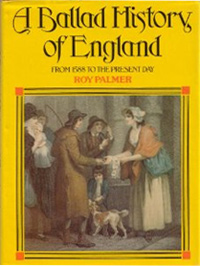
Song about enclosure of land in the Fens from 1611. Lyrics in the public domain – taken from ‘A Ballad History Of England’ by Roy Palmer.
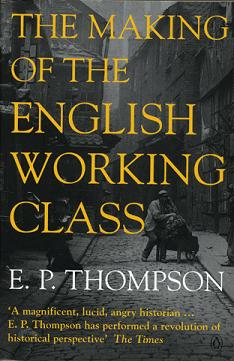
The Making of the English Working Class
by E.P. Thompson
Considered a definitive text for many years this book is dense, academically rigorous and utterly superb.
I needed a dictionary, wikipedia and a notebook to get myself through the first quarter but once up to speed with the authors style and concepts, it was as compelling a read as I have ever had.
This book has the advantage of being widely respected across all academic and historical fields in a manner which some of the other books I have read are not.
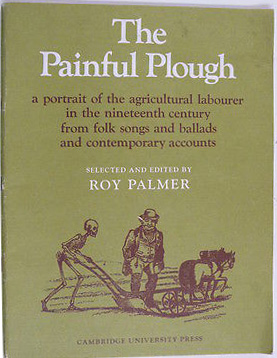
The full title is ‘The Painful Plough: A Portrait of the Agricultural Labourer in the Nineteenth Century from Folksongs and Ballads and Contemporary Accounts’ which pretty much does the job.
It tells the story of Joseph Arch, a farm labourer who went on to start one of the first agricultural labourers unions and eventually to become an MP.
A superb piece of work and a huge source of inspiration for the concept of the show ‘Three Acres And A Cow’.
Roy Palmer has spent much of the last thirty years hunting for ballads and using them to weave together a people’s history of England. He has mastered the art of this in a number of excellent books of which this is a great starting point.
This book is utterly superb and should be bought without hesitation. Each song has a melody and words, along with a page or two giving its historical context.
‘In a Dorset Lane’ by James William Walker (1831-1898)
Tim Laycock read this delightful 1884 Dorset dialect anti enclosure poem by William Barnes at our Bridport show. It includes the prophetic lines:
“The children will soon have no place for to play in and if they do grow they will have a thin mushroom face with their bodies so sumple as dough”
You can hear a reading of the poem via the youtube video below. Note how similar the Dorset accent sounds to Jamaican in places, which is no coincidence as English indentured servants would have been around African slaves during the early days of the plantations, so would have influenced their accents.
The Leane.
They do zay that a travellèn chap Have a-put in the newspeäper now, That the bit o’ green ground on the knap Should be all a-took in vor the plough. He do fancy ’tis easy to show That we can be but stunpolls at best, Vor to leäve a green spot where a flower can grow, Or a voot-weary walker mid rest. Tis hedge-grubbèn, Thomas, an’ ledge-grubbèn, Never a-done While a sov’rèn mwore’s to be won.
The road, he do zay, is so wide As ’tis wanted vor travellers’ wheels, As if all that did travel did ride An’ did never get galls on their heels. He would leäve sich a thin strip o’ groun’, That, if a man’s veet in his shoes Wer a-burnèn an’ zore, why he coulden zit down But the wheels would run over his tooes. Vor ’tis meäke money, Thomas, an’ teäke money, What’s zwold an’ bought Is all that is worthy o’ thought.
Years agoo the leäne-zides did bear grass, Vor to pull wi’ the geeses’ red bills, That did hiss at the vo’k that did pass, Or the bwoys that pick’d up their white quills. But shortly, if vower or vive Ov our goslèns do creep vrom the agg, They must mwope in the geärden, mwore dead than alive, In a coop, or a-tied by the lag. Vor to catch at land, Thomas, an’ snatch at land, Now is the plan; Meäke money wherever you can.
The childern wull soon have noo pleäce Vor to plaÿ in, an’ if they do grow, They wull have a thin musheroom feäce, Wi’ their bodies so sumple as dough. But a man is a-meäde ov a child, An’ his limbs do grow worksome by plaÿ; An’ if the young child’s little body’s a-spweil’d, Why, the man’s wull the sooner decaÿ. But wealth is wo’th now mwore than health is wo’th; Let it all goo, If’t ’ull bring but a sov’rèn or two.
Vor to breed the young fox or the heäre, We can gi’e up whole eäcres o’ ground, But the greens be a-grudg’d, vor to rear Our young childern up healthy an’ sound, Why, there woont be a-left the next age A green spot where their veet can goo free; An’ the goocoo wull soon be committed to cage Vor a trespass in zomebody’s tree. Vor ’tis lockèn up, Thomas, an’ blockèn up, Stranger or brother, Men mussen come nigh woone another.
Woone day I went in at a geäte, Wi’ my child, where an echo did sound, An’ the owner come up, an’ did reäte Me as if I would car off his ground. But his vield an’ the grass wer a-let, An’ the damage that he could a-took Wer at mwost that the while I did open the geäte I did rub roun’ the eye on the hook. But ’tis drevèn out, Thomas, an’ hevèn out. Trample noo grounds, Unless you be after the hounds.
Ah! the Squiër o’ Culver-dell Hall Wer as diff’rent as light is vrom dark, Wi’ zome vo’k that, as evenèn did vall, Had a-broke drough long grass in his park; Vor he went, wi’ a smile, vor to meet Wi’ the trespassers while they did pass, An’ he zaid, “I do fear you’ll catch cwold in your veet, You’ve a-walk’d drough so much o’ my grass.” His mild words, Thomas, cut em like swords, Thomas, Newly a-whet, An’ went vurder wi’ them than a dreat.

 The Making of the English Working Class
 The Painful Plough
  A Ballad History of England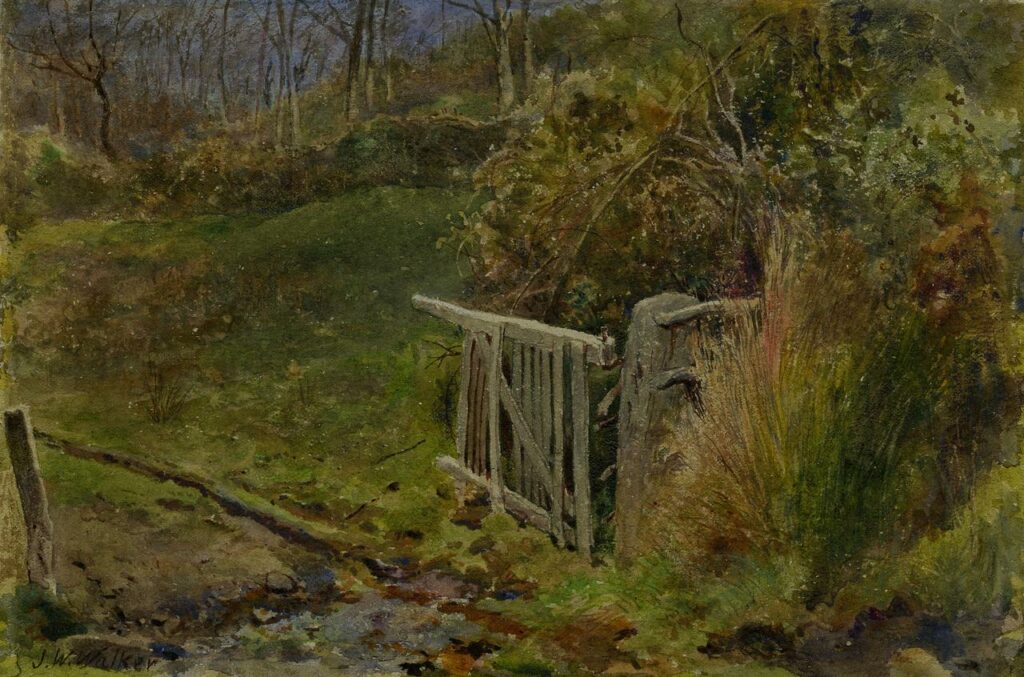
You must be logged in to post a comment.