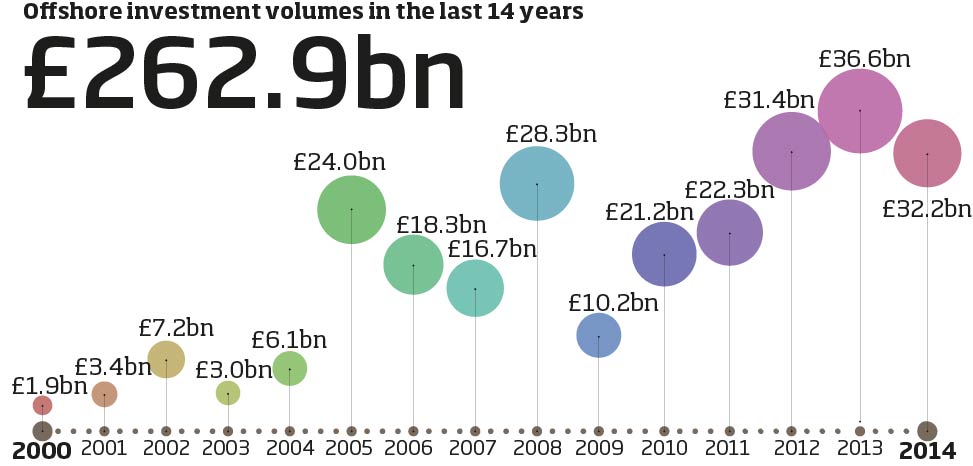
Socialism for the rich – a good article about land subsidies (or Common Agriculture Policy Single Farm Payments as they are confusingly and rather misleadingly know!)
David Cameron has said that he sees the purpose of these CAP payments to ‘rationalise the agriculture sector’… which means ‘to put small scale, family farmers and anyone who cares about soil and the environment out of business’ in politics speak.
A Community Land Trust, self build, coop design with space for food growing… Some nice work going on in Lewisham… and when I say new, I mean new to me! It looks like they have been planning this for ages and ages.
I was lucky enough to hear The Young’Uns open with ‘A Place Called England’ at a gig in Bristol last night. Here’s the original version by Maggie Holland – it won the award for Best Song at the BBC Folk Awards 1999. It’s all about gardens and English soil and has a nice reference to the diggers!
I rode out on a bright May morning like a hero in a song,
Looking for a place called England, trying to find where I belong.
Couldn’t find the old flood meadow or the house that I once knew;
No trace of the little river or the garden where I grew.
I saw town and I saw country, motorway and sink estate;
Rich man in his rolling acres, poor man still outside the gate;
Retail park and burger kingdom, prairie field and factory farm,
Run by men who think that England’s only a place to park their car.
But as the train pulled from the station through the wastelands of despair
From the corner of my eye a brightness filled the filthy air.
Someone’s grown a patch of sunflowers though the soil is sooty black,
Marigolds and a few tomatoes right beside the railway track.
Down behind the terraced houses, in between the concrete towers,
Compost heaps and scarlet runners, secret gardens full of flowers.
Meeta grows her scented roses right beneath the big jets’ path.
Bid a fortune for her garden—Eileen turns away and laughs.
So rise up, George, and wake up, Arthur, time to rouse out from your sleep.
Deck the horse with sea-green ribbons, drag the old sword from the deep.
Hold the line for Dave and Daniel as they tunnel through the clay,
While the oak in all its glory soaks up sun for one more day.
Come all you at home with freedom whatever the land that gave you birth,
There’s room for you both root and branch as long as you love the English earth.
Room for vole and room for orchid, room for all to grow and thrive;
Just less room for the fat landowner on his arse in his four-wheel drive.
For England is not flag or Empire, it is not money, it is not blood.
It’s limestone gorge and granite fell, it’s Wealden clay and Severn mud,
It’s blackbird singing from the May tree, lark ascending through the scales,
Robin watching from your spade and English earth beneath your nails.
So here’s two cheers for a place called England, sore abused but not yet dead;
A Mr Harding sort of England hanging in there by a thread.
Here’s two cheers for the crazy diggers, now their hour shall come around;
We shall plant the seed they saved us, common wealth and common ground.
Josh-Ryan Collins from the New Economics Foundation has produced a lovely piece of prose which ends with these lovely sentences:
“There is a strong case for fundamental changes in the way land is taxed, controlled and used. The speculative profits arising from owning desirable land need to be either taxed or captured by local or national governments — or perhaps communities — by owning the land themselves.
In many East Asian countries, such as South Korea, Hong Kong and Singapore, the majority of land is controlled by state corporations — public ‘land banks’. In the US and Canada, there are similar schemes at state or local government level.
These may seem like radical structural interventions for the UK. But the alternative is worsening inequality, rising prices and rents and, eventually, economic and financial collapse as the bubble bursts yet again.”
We’ve had a number of people ask us when we are going to get some of the show on youtube… Well the answer is now! Hurray for time lapse photography… it makes the show flow really nicely we think.
This podcast features some songs from the singers circle we ran at the Oxford Real Farming Conference in 2016. It includes the wonderful Ed Hamer singing the Farmer’s ABC!
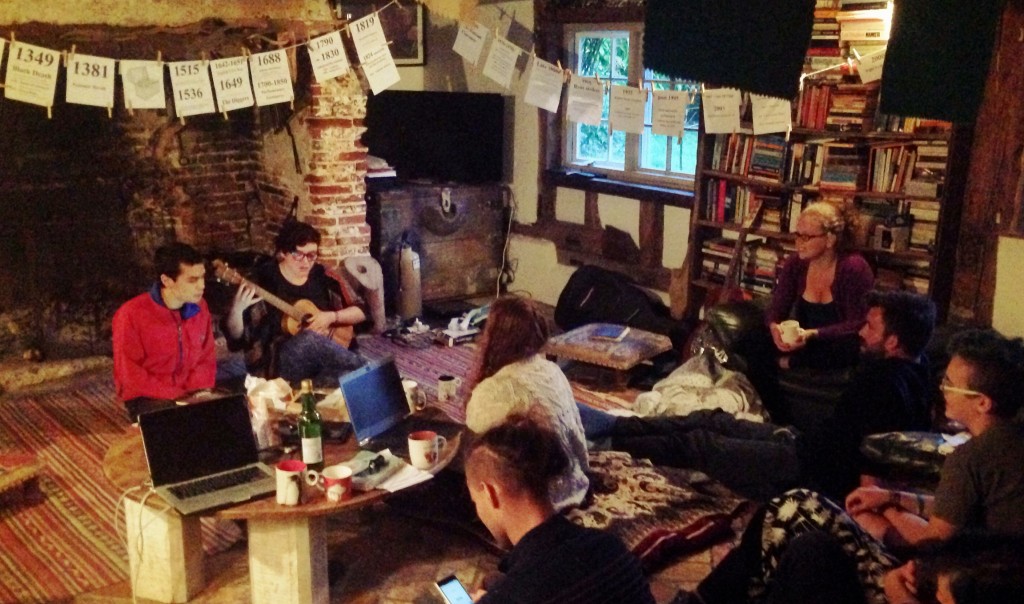
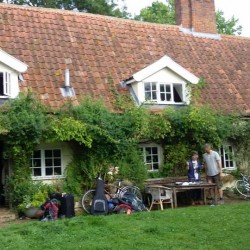
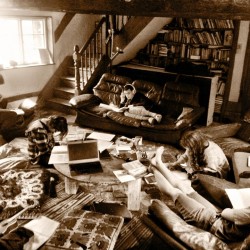
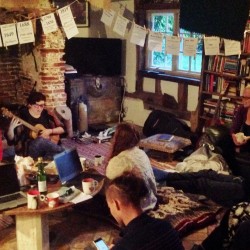
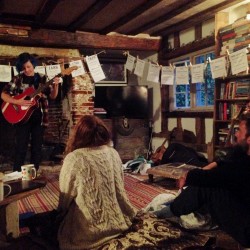
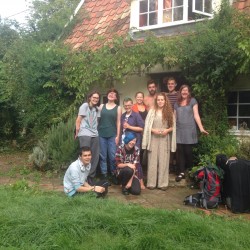
Way back in warm, sunny August, seven young people gathered somewhere in the depths of the East of England; the outskirts of a town called Diss (plenty of puns were made) in a lovely cottage, previously home to the writer Roger Deakin.
Five of us were from the youth organisation Woodcraft Folk, and we were glad to be joined by Molly and Kathleen who we hadn’t met before but quickly made friends with.
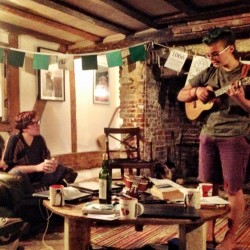
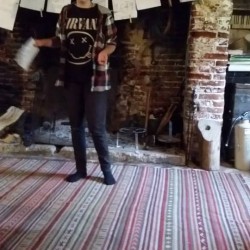
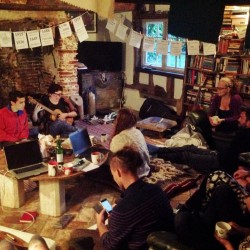
We were joined by Robin and Rachel and spent the week reading, singing and learning all about the history of our land and the struggles that have been fought for it. We listened to podcasts, taught each other songs and shared food together between practicing sections of the show ready for a performance.
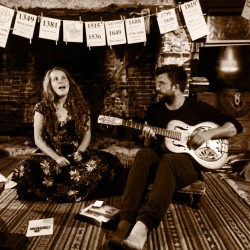
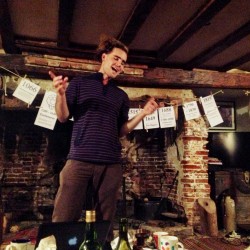
At the end of the week, we performed a full show of Three Acres and a Cow as a group, complete with poetry, sketches and, of course, singing.
Since the residency, Anna has successfully applied for funding to develop a Quaker version of the show alongside Robin, and I have been involved in various performances of the show in my new role as youth apprentice.
Here is a selection of photos from the week:
Naomi
Outside
Moll
The team watch Robin and Rachel performing
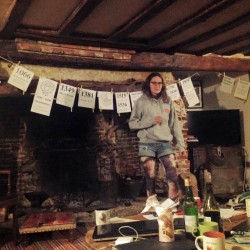
Anna
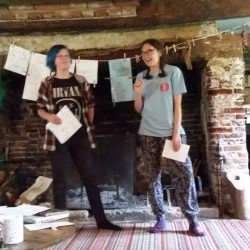
Molly and Anna perform their English Civil War sketch
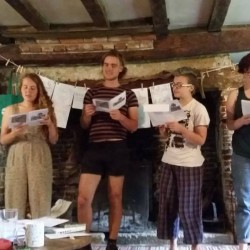
Kathleen, Pip, Naomi and Georgie sing together in the final performance of the week
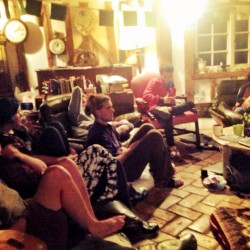
Everyone hard at work reading
Toby and Georgie sing a duet
Kathleen sings with Nick
Pip doing his thing during the youth residency 2015
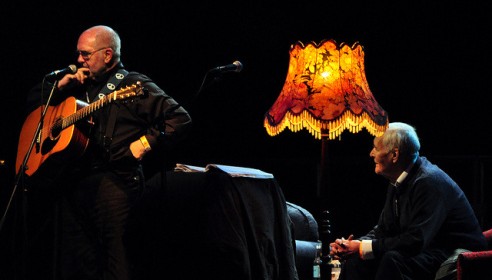
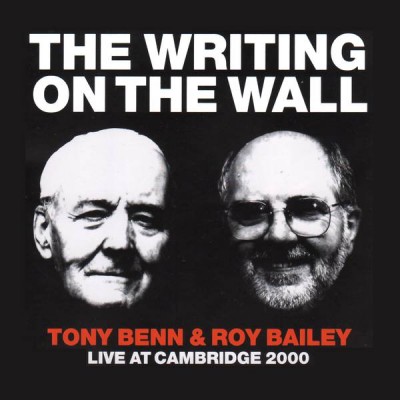
Tony Benn and Roy Bailey used to tour a show called ‘The Writing on the Wall’ which has much overlap with the spirit, content and format of ‘Three Acres And A Cow’.
There is a newspaper review of one of the shows here and it can be found on iTunes, Spotify and many other virtual and real places… You might be able to stream it from the player below if you are lucky!
I can’t remember where I stumbled across this but it has some good posts useful for staying up to date with where the Scottish land reform movement is at.
Here is the personal website of Dr Macleod – more interesting stuff on it but i confess to having not given it the reading time it undoubtedly deserves right now – http://www.calummacleod.info/projects.html
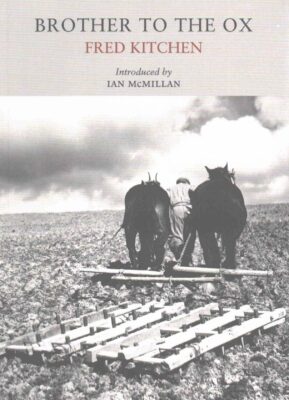
This book is a stunning and gentle insight into being a farm labourer just as the railroads arrive. I read it ages ago then recently picked it up again and found I couldn’t stop myself from rereading the whole book, it was just so enjoyable to turn the pages and spend time with Fred Kitchen.
Little Toller books recently did a reprint of Brother to the Ox, which is already out of print but you can find them 2nd hand online for around the £10-15 mark fairly regularly.
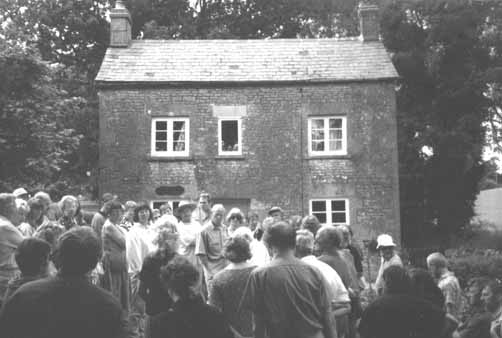
A group of socialists bought 41 acres of land in the Cotswolds in 1898 and then burnt the deeds… Pretty radical stuff and one of the only ones still keeping many of its ideals alive today, largely as they have no choice!
We’d like to visit Whiteway Colony very much indeed – if anyone knows someone who lives there please do give them a nudge 😉
“The song became a Liberal radical anthem in the aftermath of David Lloyd George’s “people’s budget” of 1909 which proposed a tax in land. During the two general elections of the following year, ‘The Land Song’ became the governing Liberals’ campaign song.” (from https://en.wikipedia.org/wiki/The_Land_song)
Sound the blast for freedom, boys, and send it far and wide,
March along to victory, for God is on our side,
While the voice of nature thunders o’er the rising tide:
“God made the land for the people”.
The land, the land, ’twas God who made the land,
The land, the land. The ground on which we stand,
Why should we be beggars with the ballot in our hand?
God gave the land to the people.
Hark! The shout is swelling from the east and from the west!
Why should we beg work and let the landlords take the best?
Make them pay their taxes for the land, we’ll risk the rest!
The land was meant for the people.
The banner has been raised on high to face the battle din,
The army now is marching on, the struggle to begin,
We’ll never cease our efforts ’til the victory we win,
And the land is free for the people.
Clear the way for liberty, the land must all be free,
Britons will not falter in the fight tho’ stern it be.
‘Til the flag we love so well shall wave from sea to sea,
O’er the land that’s free for the people.
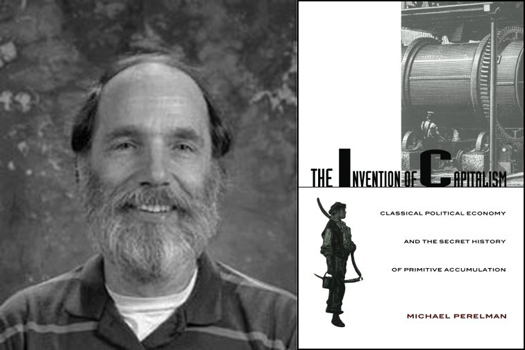
I’d love to say I’ve read this but it would be a lie – the book review which the below quote came from gave me an excellent overview though! If any of you feel inclined to give it a read, please do let me know if you enjoy it. You can download a pdf of the book here.
This book explores the many different policies through which peasants were forced off the land—from the enactment of so-called Game Laws that prohibited peasants from hunting, to the destruction of the peasant productivity by fencing the commons into smaller lots—but by far the most interesting parts of the book are where you get to read Adam Smith’s proto-capitalist colleagues complaining and whining about how peasants are too independent and comfortable to be properly exploited, and trying to figure out how to force them to accept a life of wage slavery. (from good book review which is a useful essay in itself)
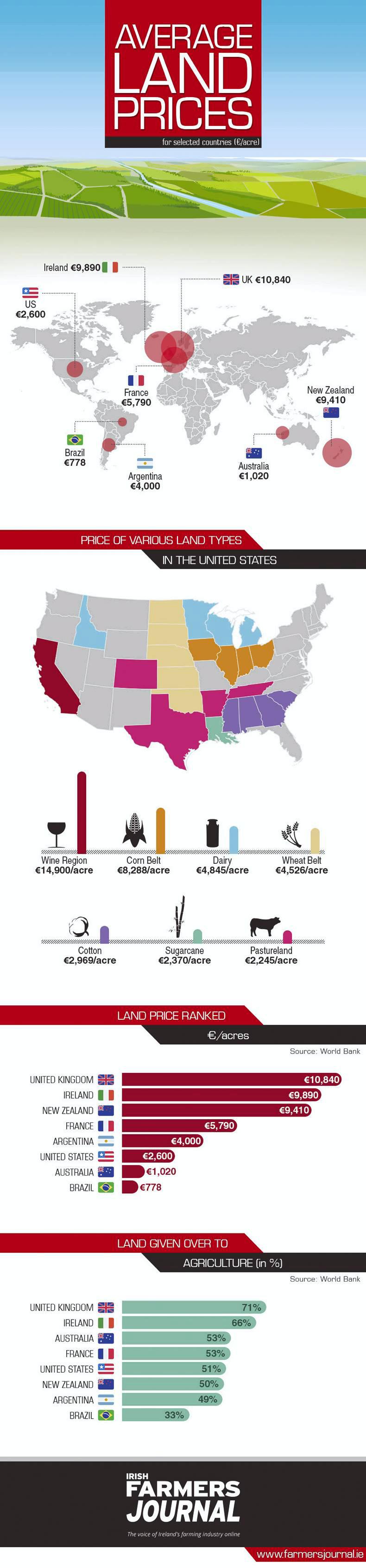
Do we have the highest land prices in the world because we have the best soil? Or is it because of the huge tax breaks and generous payments made to land owners through public subsidies?
I just got sent this link by a friend and whilst I have not had a chance to browse all the English entries, what I have read is useful and inspiring – http://nvdatabase.swarthmore.edu/
This song by Peggy Seeger is about the St Pancras rent strikes in 1960
HEY HO! COOK AND ROWE! (Or The Landlord’s Nine Questions)
In 1960, the local council of the Borough of St. Pancras raised the rents of municipal flats. Many working people found it difficult to meet the increased financial burden imposed upon them by these rents and, under the leadership of two “desert rats” (Don Cook and Arthur Rowe), they organized a rent-strike which in a matter of two or three weeks became a national topic of conversation. The council’s bailiffs were sent in but were repelled after a preliminary skirmish and from that time on the rent strike took on the character of a military siege.
The tenants barricaded the buildings with barbed wire, old pianos and junk of all kinds, and from sympathisers the country over came a constant supply of canned food. The television coverage provided Britain with one of its most popular daily shows. An army of the police finally battoned their way through demonstrators to find that their only possible point of entry was through the roof. A group of intrepid police officers effected an entry and were greeted with the offer of a cup of tea from the strikers’ general staff.
HEY HO! COOK AND ROWE!
(or: The Landlord’s Nine Questions)
Words and Music by Peggy Seeger
As true a story I’ll relate
(With a) HEY HOI COOK AND ROWE!
How the landlord told Don Cook one night,
(With a) HEY HO! COOK AND ROWE!
You must answer questions nine
(With a) HEY HO! COOK AND ROWE!
To see if your flat is yours or mine
(With a) HEY HO! COOK AND ROWE!
CHORUS:
Hey, ho, tell them no
With a barb-wire fence and a piano,
Took a thousand cops to make them go,
Three cheers for Cook and Rowe!
What is higher than a tree? (With a, etc.)
And what is lower than a flea?
My rent is higher than a tree,
And the landlord’s lower than a flea.
(CHORUS)
What goes on and never stops?
And what is gentler than a cop?
The tenants’ fight will never stop
And the devil is gentler than a cop.
(CHORUS)
What is stronger than a door?
And tell me what a roof is for?
Barb-wire is stronger, here’s your proof,
The bailiffs came in through the roof.
(CHORUS)
Will you get off my property?
Or will you pay the rent to me?
We’ve settled in as you can see,
Now, won’t you stop for a cup of tea?
(CHORUS)
O, now I’ve lost my board and bed,
I’ll barricade the streets instead.
So all you tenants, settle in,
Keep up the fight, you’re bound to win.
(CHORUS)
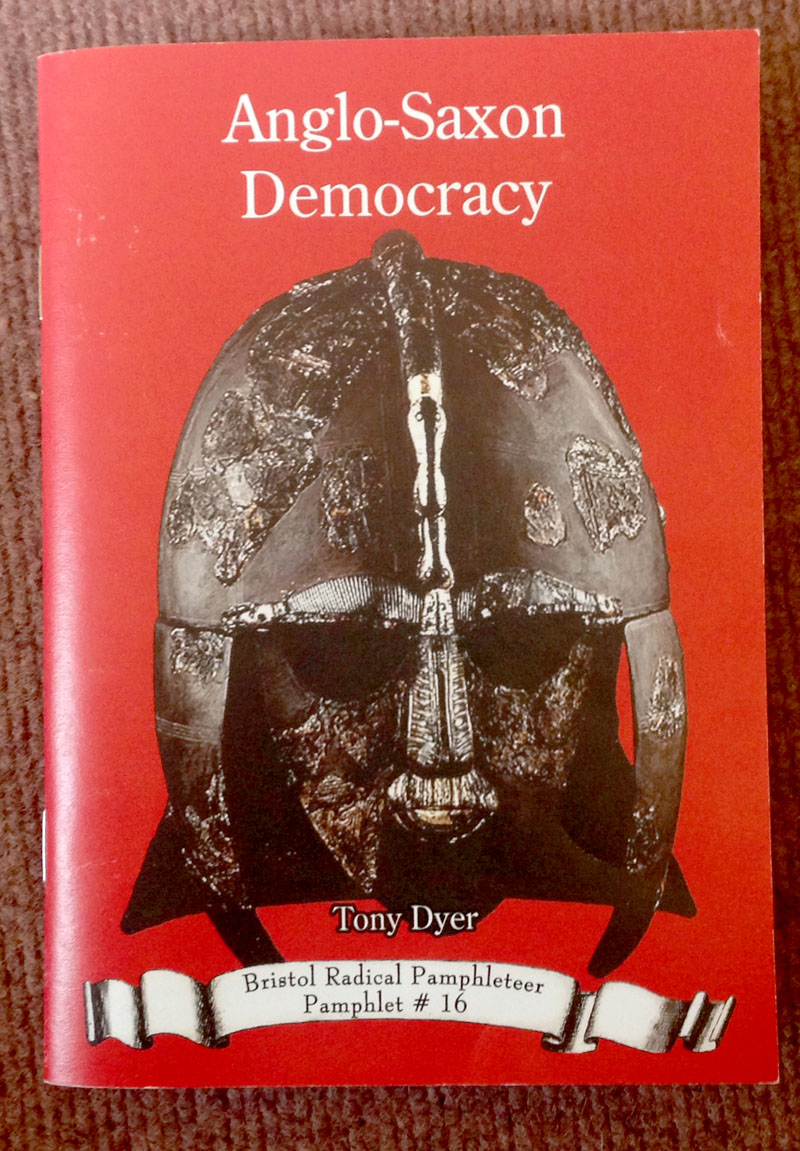
I have been really enjoying reading a number of pamphlets which I picked up recently from ‘Bristol Radical History Group‘ who seem to do a lot of great work down in the south west.
This one on Anglo-Saxon Democracy is of particular interest, although there are many others which I will write up at some point soon.
These few paragraphs are good food for thought, the italics in the last paragraph are mine:
———————————-
The Rise of the Church
If the major cause of the retreat of Anglo-Saxon democracy is the increasing use of charters to create bookland beyond the control of the local courts and thus the local community then it also has to be accepted that the use of charters to gain rights and privileges at the expense of the local populace was first introduced by the Roman Catholic church and all of the charters of pre-Conquest England were denrived from the form of the private charter of the later Roman empire. Continue reading →
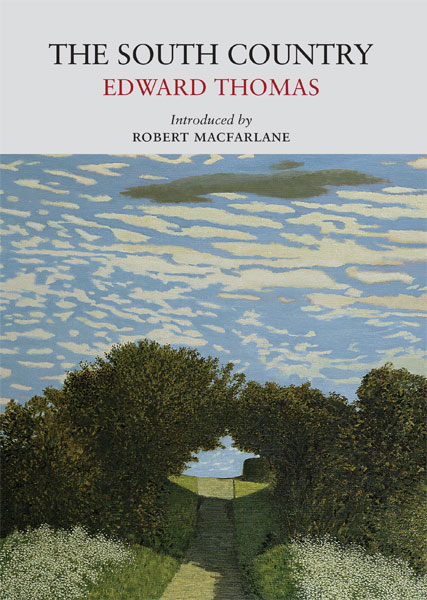
255-7 THE END OF SUMMER KENT BERKSHIRE — HAMPSHIRE SUSSEX THE FAIR
The road mounts the low Downs again. The bound-less stubble is streaked by long bands of purple-brown, the work of seven ploughs to which the teams and their carters, riding or walking, are now slowly descending by different ways over the slopes and jingling in the rain. Above is a Druid moor bounded by beech-clumps, and crossed by old sunken ways and broad grassy tracks. It is a land of moles and sheep. Continue reading →

 This book is a stunning and gentle insight into being a farm labourer just as the railroads arrive. I read it ages ago then recently picked it up again and found I couldn’t stop myself from rereading the whole book, it was just so enjoyable to turn the pages and spend time with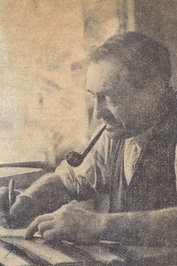

 I have been really enjoying reading a number of pamphlets which I picked up recently from ‘